This September, a Cionic Neural Sleeve user issued a challenge to us we couldn’t refuse.

Finally got to try out the sleeves while riding. Made it almost 5 miles in 32 minutes, my foot is floppy as h*ll. Cionic, Maddi, Dylan, Jeremiah, calf/shin need to be involved in order to keep the feet from flopping off. That's my input. Other than that, it was a great ride.
It is a poorly kept secret at Cionic that tagging the team on social media with a juicy physical challenge will most certainly get our creative juices flowing. While some requests may take us years to research, this was one that we knew we could turn around quickly.
FES Cycling with the Neural Sleeve
FES cycling has been used since the 1960s, especially by people with spinal cord injury, to help maintain muscle mass, increase circulation, and improve cardiovascular health. Training with the FES cycle for durations as short as 12 weeks, or as long as 6 months, can lead to cardiorespiratory and muscle benefits, as well as vascular improvements, in people with both chronic and acute, complete or incomplete, tetraplegia or paraplegia. In fact, even people with complete injury obtain health-related benefits from FES cycling.
For Neural Sleeve users who exercise on a recumbent or upright bicycle, our Cycle Program has long offered a way to integrate cycling into training through the Cionic App. Whether cycling on a stationary bike or outdoors, the Cycle Program sequences muscle stimulation to support an effective pedal stroke.
Challenge Accepted: Listening to Users to Improve Cycling
Once Adam put his challenge out there, we spoke with other users of the Cycle Program to understand their experience. Turns out Adam wasn't alone. Users with high spasticity or tone consistently reported difficulty keeping their foot in the pedal.
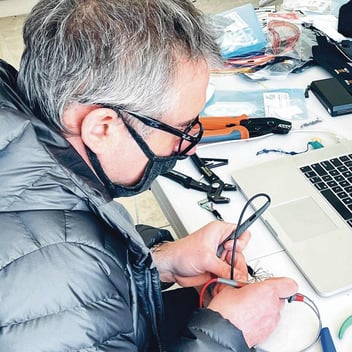
To understand why we went back to the early days of FES cycling at Cionic. We first started working on cycling back in 2020, when the Neural Sleeve was a cobbled-together collection of hand-soldered breadboards, home-made straps, and a mess of wires. It was also during the peak of the COVID-19 pandemic, so we had limited access to external study participants. Still, the team made do — collecting data and experimenting with stimulation on themselves and a few brave volunteers from collaborators at Stanford (some of whom rode with the Stanford cycling team).
Early FES Cycling Efforts at Cionic
The primary motivation for this group was improving the Quad-Hamstring ratio. Most amateur cyclists tend to be quad dominant only engaging the quadriceps to push the pedal down. The world's best cyclists also leverage the hamstrings to pull the pedal up, creating a more fluid efficient pedal stroke.
As a result, the workflow that became the template for much of our future work mapped stimulation patterns and timing for quadriceps and hamstring muscles, and not other muscles of the leg.
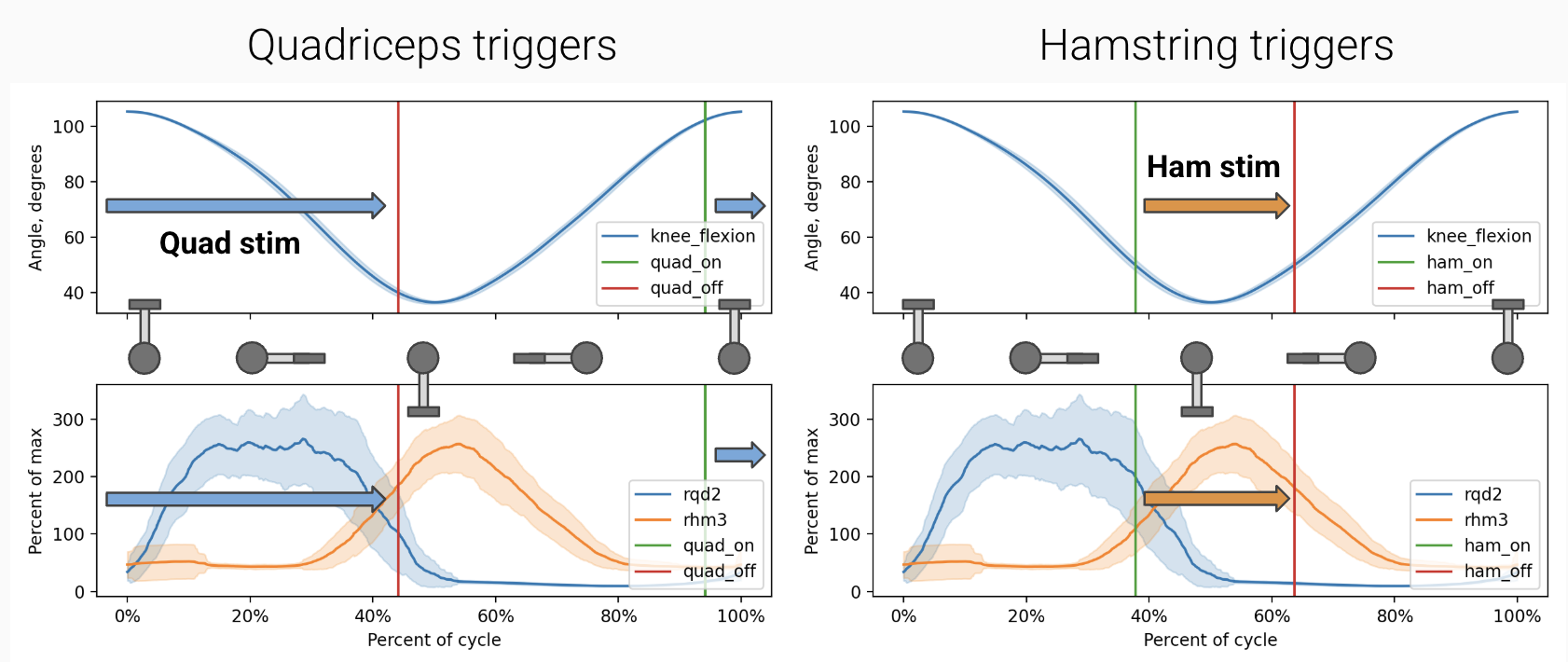
Mapping of EMG muscle activations to knee flexion of Quadriceps and Hamstring during cycling
Early recording of stimulation driven pedal stroke
New Cycling Program Incorporates Calf and Shin Muscles Stimulation Into FES Cycling
From listening to our users, however, it became clear that we needed to focus on the lower leg as well. So the team went back and repeated the same data collection process with the lower leg, recording orientation and muscle firing data. To get good clean EMG data on which to train our algorithms, it was important to emphasize completing the push phase through the calf muscle, and initiating the sweep phase with the tibialis anterior (TA).
And we wanted to make sure the trigger timing was appropriate for a variety of cycling positions, so we collected data in both upright and recumbent positions.
The updated Cycle Program answers the needs of our users: While the original program focused on stimulating the thigh muscles (quadriceps and hamstrings) to power the pedal stroke, the updated version also activates lower-leg muscles — particularly the shin and calf muscles — to improve ankle control and help keep the foot stable on the pedal.
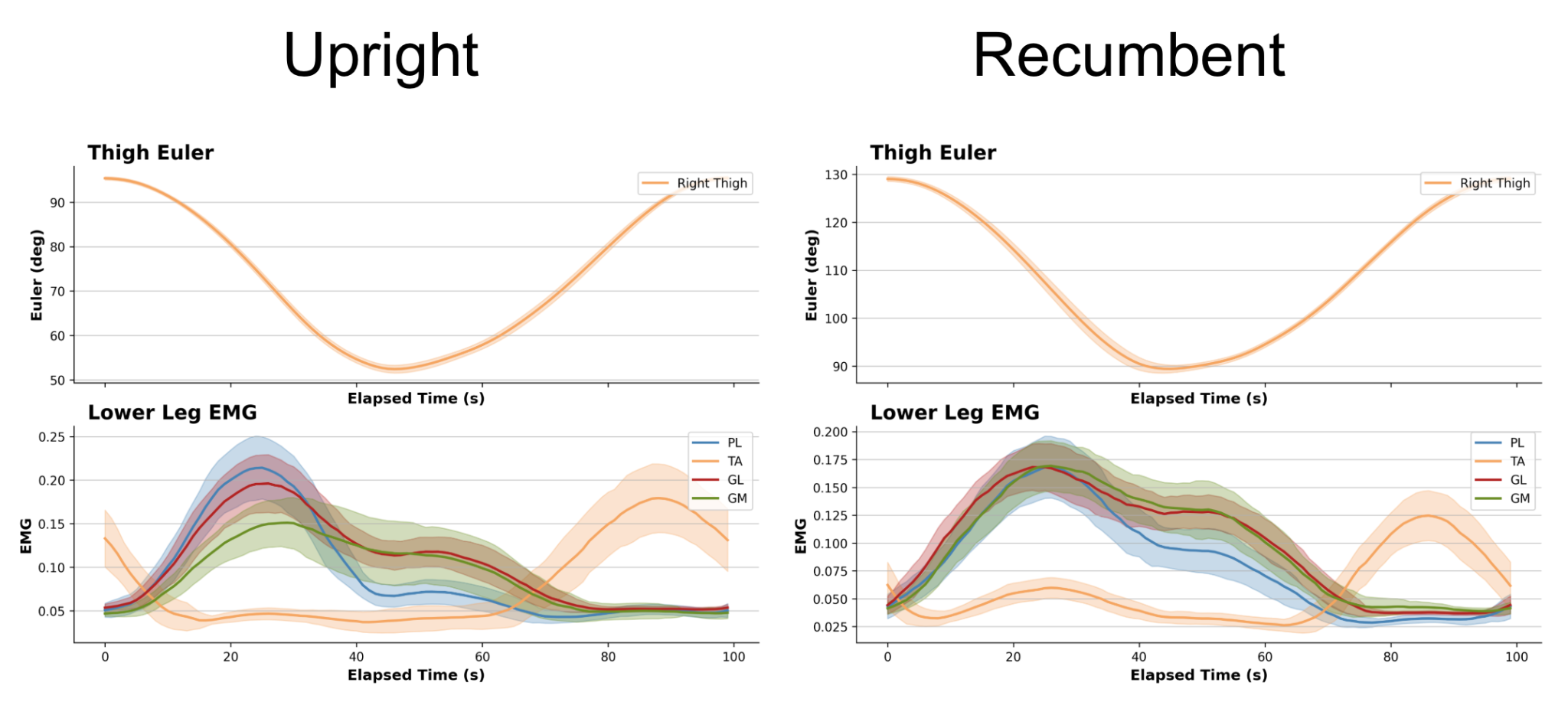
Recording of lower leg EMG vs. thigh angle in upright and recumbent cycling
Positive Feedback from Real-World Testers
Back before the 2023 launch of the first Neural Sleeve, we brought users into the Cionic office, or to one of our partner sites to test out new programs. Now there is a community of thousands of Cionic users across a number of different diagnoses, and a robust platform for testing new software in the real world.
We recruited a cohort of individuals across multiple sclerosis, stroke, and spinal cord injury to test the new program with their home exercise bikes and provide feedback.
The feedback was hugely positive with participants reporting greater endurance, higher stroke cadence, and longer distances.
The best part? Their feet were no longer struggling to stay on the pedal.
Benefits of FES Cycling
The research on the benefits of FES cycling continues to grow. FES cycling early after injury (less than one year) does not appear to be harmful to the muscles, as was demonstrated in the two studies that were conducted in persons with acute SCI. The muscle size increased, potentially preventing and overcoming the early onset muscle atrophy reported in persons with SCI. Finally, persons with tetraplegia received benefits from exercising on the FES cycle, which is particularly meaningful given their high risk for cardiovascular disease. - https://www.bu.edu/drrk/research-syntheses/spinal-cord-injuries/fes-cycling/
In addition to using electrical stimulation to activate muscles, traditional FES cycles incorporate a variable strength motor to provide additional assistance. These machines range in cost from $10k - $30k, often limiting use to clinical settings. The RT300 by Restorative Therapies and the MyoCycle by Myolin are two of the leading FES cycling solutions available today.
For individuals who can achieve pedal stroke through stimulation alone and want to integrate FES cycling into a broader gait training program, the Cionic Neural Sleeve offers a great alternative to traditional FES cycles.
For Cionic users looking for additional ways to gain strength and mobility through additional activities, the updated Cycle program is available now and offers a fantastic complement to our Gait and Training programs.
Want to learn more? Contact your Cionic Mobility Specialist or email us at info@cionic.com.